Quick Overview
Every plot has a legal limit on how much total floor area can be built on it, called the Floor Area Ratio (FAR). Knowing what FAR is in real estate shows how crowded a building may be and whether it was built as approved.
- FAR compares a building’s total floor space with the size of its plot.
- In Bengaluru, larger plots on wider roads are usually allowed a higher FAR.
- Buyer tip: Always verify FAR on the sanctioned plan, not the sales brochure.
What Is FAR in Real Estate?
FAR is a rule set by the local planning authority on how much total floor space a building can have.
- FAR full form and meaning: FAR stands for Floor Area Ratio. In construction, FAR is the maximum floor space allowed on a plot, expressed as a number.
- What the number tells you: A FAR of 2 means all floors combined can be twice the plot size.
What Does Floor Area Ratio Mean in a Simple Formula?
The Floor Area Ratio meaning is easiest to see as a formula.
- The formula: FAR = total floor area of all floors ÷ plot area.
- Maximum space you can build: Plot area × allowed FAR. A 1,500 sq. ft. plot with a FAR of 2 allows 3,000 sq. ft.
- Different ways of writing it: 2:1, 2.0 and 200 can all mean the same FAR.
How Do You Calculate Floor Area Ratio?
Follow three steps.
- Step 1: Find the plot size: Use the area in your property documents.
- Step 2: Add up the floor space: Add the area of every floor, excluding uncounted spaces like parking.
- Step 3: Divide: Divide total floor space by plot size.
Example:
- A 30 x 40 ft plot is 1,200 sq. ft.
- At a FAR of 1.75, you can build up to 2,100 sq. ft.
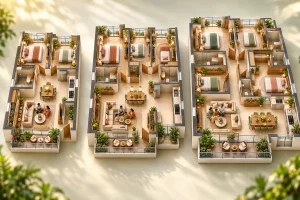
- A house with 720, 720, and 600 sq. ft. on three floors totals 2,040 sq. ft., a FAR of 1.70, within the limit.
What Counts in FAR and What Does Not?
The meaning of FAR in construction depends on which spaces are counted.
- Usually counted: Bedrooms, living rooms, kitchens and bathrooms.
- Usually not counted: Basement and ground-level parking, lift machine rooms, water tanks and fire-safety areas. Open balconies are counted only partly.
- Why rules differ: Each city decides what to count.
What Is the Difference Between FAR vs FSI vs FSR?
These are three names for the same idea.
| Term | Full form | Where you may see it | What it means |
|---|---|---|---|
| FAR | Floor Area Ratio | National building rules and many states | Total floor space compared with plot size |
| FSI | Floor Space Index | Common in Maharashtra and sale documents | Same as FAR |
| FSR | Floor Space Ratio | Some older or local rules | Same as FAR |
- Where FSR appears: Mainly in older or local building rules.
- Which term to follow: The one in your approved building plan.
Why Does FAR Matter Before You Buy or Build?
FAR matters in real estate in different ways, depending on your goal.
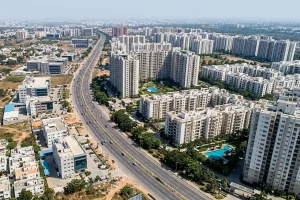
- For homebuyers: Higher FAR usually means more homes on the same land, so check for enough open space.
- For plot owners: FAR tells you how big a house you can legally build.
- For investors: A higher allowed FAR can add to a plot’s value.
What Should You Know About Limits, Height, and Premium FAR?
1. Higher FAR Does Not Always Mean More Floors
Even if your plot allows a high FAR, you cannot build as tall as you want. Safety and fire rules still cap your building’s height. In cities like Bengaluru, the taller a building goes, the more open space you must leave around it, so you may run out of ground space before using your full FAR.
2. Open-Space Rules Reduce Usable Area
Building laws require you to leave empty gaps, called setbacks, between your building’s walls and your plot boundaries for sunlight, airflow, and emergency access. These mandatory gaps shrink your usable floor area. Additionally, if your plot is near a lake or a heritage site, local protection laws will further limit your building size.
3. What is Premium FAR?
Think of Premium FAR as buying extra building space directly from your local city authority.
While every plot comes with a standard building limit (Base FAR), the government lets you pay a fee to construct additional floors or square footage beyond that limit.
4. How it works in Karnataka
In February 2025, Karnataka introduced this rule for plots on roads at least 30 feet (9 metres) wide. After updating the policy in February 2026, the rules depend on the width of the road facing your plot:
- Roads 39 feet (12 metres) and wider: You can pay a fee directly to the authority to unlock extra building space (Premium FAR).
- Roads between 30 and 39 feet (9 to 12 metres) wide: You cannot buy Premium FAR with cash. Instead, you can only get extra space using Transferable Development Rights (TDR), which are special construction credits purchased from other landowners who gave up land for public projects like road widening.
| Plot Size (sq. ft.) | Road Width (ft.) | Base FAR (Residential) |
|---|---|---|
| Up to 3,875 sq. ft. | Up to 39 ft. | 1.75 |
| Above 3,875 to 10,764 sq. ft. | Above 39 ft. to 59 ft. | 2.25 |
| Above 10,764 to 21,528 sq. ft. | Above 59 ft. to 79 ft. | 2.50 |
| Above 21,528 to 43,056 sq. ft. | Above 79 ft. to 98 ft. | 3.00 |
| Above 43,056 to 2,15,278 sq. ft. | Above 98 ft. | 3.25 |
What Is a Quick FAR Checklist for Property Decisions?
- Check the approved plan: Compare its FAR with what was built.
- Confirm the local rules: Bengaluru’s authorities follow different rules.
- Ask what was counted: Find out how balconies, parking and terraces were treated.
- Match FAR to your needs: A home, rental or resale plot each needs different space.
What Are Common FAR Mistakes and Misreadings?
Most FAR mistakes in real estate come from three assumptions.
- Mixing up carpet area and floor area: Carpet area is the usable space inside walls; FAR uses the larger total floor area.
- Assuming FAR is the same everywhere: It changes with area, road width and plot size.
- Ignoring the approved plan: Space built beyond it is a violation that can affect home loans and the occupancy certificate.
Conclusion
Understanding FAR in real estate turns a technical term into a practical way to evaluate your future home. It helps you see how open or crowded a community will feel and reassures you that the building is legally constructed. When you compare the approved building plan against the FAR rules, you get clear peace of mind that your home is safe, compliant, and built to last.
FAQs
1. What is FAR value?
FAR value shows how much floor space is allowed relative to the plot size. The local authority sets it.
2. What does FAR 2.5 mean?
It means total floor space can be up to 2.5 times the plot size. On a 2,000 sq. ft. plot, you could build up to 5,000 sq. ft. across all floors.
3. What is the FSI for 10,000 square feet?
It depends on location and road width. In Bengaluru, a 10,000 sq. ft. plot on a 40-60 ft road usually has a FAR of about 2.5, allowing around 25,000 sq. ft.
4. What is FAR and TDR?
FAR is the standard amount of floor space allowed on a plot. Transferable Development Rights (TDR) are special building credits given to landowners who surrender part of their land for public projects, like new roads or parks. Builders can buy these credits to construct extra floor space on another plot, within approved limits.
5. What is the difference between GFA and GLA?
Gross Floor Area (GFA) is a building’s total floor space, including corridors. Gross Leasable Area (GLA) is only the space rented to tenants, mostly in offices and shops.
6. How many floors are allowed on a 2,400 sq ft plot?
A 2,400 sq. ft. plot usually has a FAR of about 1.75, allowing about 4,200 sq. ft. If about 60% of the plot can be built on, that is roughly a ground floor plus two floors, subject to local approval.